|
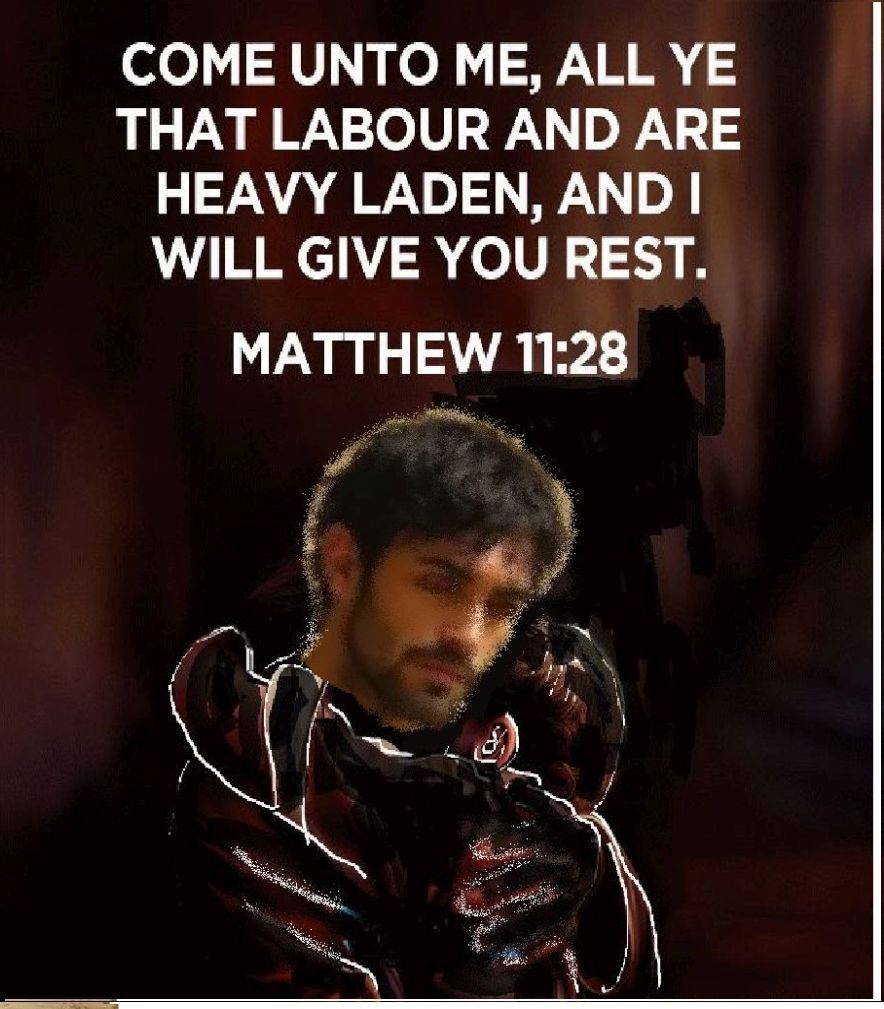
Jesus calls to himself all such as feel their burden in Matthew 11:28-30:
"28Come unto me, all ye that labour and are heavy laden, and I will give you rest. 29 Take my yoke upon you, and learn of me; for I am meek and lowly in heart: and ye shall find rest unto your souls. 30For my yoke is easy, and my burden is light. "
THE "REST" THAT JESUS OFFERS
One of the Hebrew words for rest is sabbath. For example, in Genesis 2:3 God blessed and sanctified the seventh day as His sabbath from creating. During the Patriarchal "pre- and post- flood" historical periods, no requirement or command is given for observance of any kind.
But then God does require sabbath [rest] days observances under the Mosaic Covenant Law for Israel to honor God for giving them rest from Egyptian slavery: Deuteronomy 5:15.
What about the New Covenant of Jesus Christ? Hebrews 10:8,9 -- "8Sacrifice and offering ..which are offered by the law; [Mosaic Covenant Law]. 9Then said he, Lo, I come to do thy will, O God. He taketh away the first [Covenant--Mosaic Law], that he may establish the second [Jesus' Covenant]."
The New Testament uses the same "rest" words as the Old Testament Greek translation (LXX), especially the Greek "pause" rest words. Matthew
11–12 use ἀνάπαυσις
/ ἀναπαύω ("refreshment"-rest),
while Hebrews 3–4 use κατάπαυσις
/ καταπαύω (God’s
covenant “settled” -rest) and σαββατισμός
(Hebrew word for "Sabbath"-rest borrowed into the Greek). They overlap in the idea
of rest, but the Greek words'
emphasis is different.
1. Matthew
11–12: The “Rest” Jesus Offers
Jesus spoke these words during a time of spiritual exhaustion among the people. I mean by that that John the Baptist was imprisoned, many cities refused to repent, and religious leaders (e.g., Pharisees) imposed heavy burdens of added traditions.
The "labour" refers to toil to the point of exhaustion, and "heavy laden" evokes the image of a beast of burden.
This invitation is especially emotional in a world marked by political unrest, moral decay, and personal despair.
Key Greek "pause" words:
ἀνάπαυσις
(anapausis) — (noun) “refreshment,
relief, rest”
ἀναπαύω
(anapauō) — (verb) “to give
rest, refresh”
Where it appears:
Matthew 11:28–29 — “I
will give you rest… you will find rest for your
souls.” → Jesus offers relief, refreshment,
renewal from burdens.
Compare how it is used in Matthew 12:43 — “seeking rest”
(referencing the unclean spirit seeking rest) → same word group as in chapter 11; therefore, meaning “a place of
relief.”
Meaning in context:
Not cessation of work, but rest
within work — a harmonious, soul-level
refreshment. Whereas "rest" in the Old Covenant was a pause in physical labor, this was a rest within the soul. Jesus' open invitation to all who are spiritually exhausted, burdened by sin, legalism, or life's hardships, offering them true rest found only in Him.
Vine's Dictionary notes that
ἀνάπαυσις is the
constant Septuagint word (Old Testament Greek translation) for the "Sabbath" rest, but Jesus uses it in a
personal, relational sense rather than the institutional
Sabbath-day-keeping. This is certainly a contrast with the human rules and regulations that affected routine seventh-day sabbaths.
2. Hebrews 3–4: Three Greek
“rest” words different from Matthew
Hebrews, on the other hand, uses a cluster of Greek terms with
precise Biblical distinctions. They are different than the ones in Matthew. Two are them are Greek "pause" words.
A. First, κατάπαυσις
(katapausis) —
“God’s rest”**
This one occurs repeatedly in Hebrews 3–4. Meaning: settled
rest, abode, the place of God’s
rest. It is used in the Psalm 95 quotation: “They shall not
enter My rest.”
|
Quote from Psalm 95:8 "Harden not your heart, as in the provocation, and as in the day of temptation in the wilderness: 9 When your fathers tempted me, proved me, and saw my work. 10 Forty years long was I grieved with this generation, and said, It is a people that do err in their heart, and they have not known my ways: 11 Unto whom I sware in my wrath that they should not enter into my rest.
|
B. Second, καταπαύω
(katapauō) — “to cause to
rest / to cease”**
Verb form: “to give rest,” “to cease from
works.” Appears in Hebrews 4:10.
Hebrews 4: 10 "For he that is entered into his rest, he also hath ceased from his own works, as God did from his." |
C. Third, σαββατισμός
(sabbatismos) — “Sabbath-rest”** Note: this is not an original Greek word; Greek apparently borrowed it from the Hebrew language.
Hebrews 4:9 "There remaineth therefore a rest σαββατισμός to the people of God."
σαββατισμός
Abbott-Smith's Manual Greek Lexicon of the New Testament
Strong's #G4520
to keep the sabbath, Exo 16:30, al.),
a keeping sabbath, a sabbath rest: metaph., as in Mishna (Zorell, s.v.), Heb 4:9.
|
This occurs only this
once in the
entire NT: Hebrews 4:9.
It means: Sabbath-keeping, relating to our death, judgment, and the final destiny of the soul and of humankind:
Sabbath rest for God’s people. The author
deliberately shifts from the Greek pause word κατάπαυσις
to the Hebrew derived σαββατισμός
to make a Biblical point.
Uses three rest-related terms with layered
meaning:
|
Greek Term
|
Meaning
|
Function in Hebrews
|
|
κατάπαυσις
|
God’s rest / settled abode
|
The “rest” Israel failed to enter; the promise
believers may enter
|
|
καταπαύω
|
To cause to rest / cease
|
Describes believers ceasing from their works as God did in Genesis
|
|
σαββατισμός
|
Sabbath-rest
|
A unique, climactic term: the Sabbath-like eschatological
rest that “remains”
|
The Spirit in Hebrews builds a Biblical argument from Psalm
95, the creation rest, and Israel’s failure—something
Matthew 13–14 does not touch at all.
3. Hebrews 3–4: The “Rest”
That God Offers the Believer
Hebrews uses two different Greek terms, plus the Hebrew sabbath word, each
with a distinct nuance (i.e., "a subtle distinction or variation").
A. κατάπαυσις
(katapausis) — “settled rest, God’s
resting place”
Occurs repeatedly in Hebrews 3–4.
Root idea: cessation, settling
down, the place of God’s rest.
Used in Hebrews 3:11, 3:18, 4:1, 4:3, 4:5, 4:10, 4:11.
3:11“ So I sware in my wrath, They shall not enter into my rest. ”
3:18“ And to whom sware he that they should not enter into his rest, but to them that believed not?”
4:1 “Let us therefore fear, lest, a promise being left us of entering into his rest, any of you should seem to come short of it.”
4:33 “For we which have believed do enter into rest, as he said, As I have sworn in my wrath, if they shall enter into my rest: although the works were finished from the foundation of the world”
4:55 “And in this place again, If they shall enter into my rest. ”
4:10“For he that is entered into his rest, he also hath ceased from his own works, as God did from his. ”
4:11 “Let us labour therefore to enter into that rest, lest any man fall after the same example of unbelief”
Strongly tied to prophesy of Psalm 95 (“My
rest”).
Represents the Promised Land rest, God’s
own rest, and the eternal rest
believers may enter.
B. καταπαύω
(katapauō) — “to cause to rest, to give
rest”
C. σαββατισμός
(sabbatismos) — “Sabbath-keeping rest”
Occurs only once in the NT: Hebrews 4:9.
Means Sabbath observance, but in Hebrews it
points to the final, eschatological Sabbath-rest
for God’s people.
"Scholars widely note the author likely coined
this term to make a theological point." --AI.
4. What’s Common Between Matthew
and Hebrews?
Shared conceptual background
Both draw from the OT Hebrew language's "rest" vocabulary
(נוּחַ
nuach, מְנוּחָה
menuchah) as mediated through the
Septuagint's Greek translation of the Old Testament that was being used by the synagogues during first century.
Both involve relief from burdens and entry
into God’s intended rest which the Old Covenant served as a shadow --Colossians 2:14-17:.
Shared linguistic root
5. What’s Different Between the books
Matthew and Hebrews?
A. Different Greek words
|
Passage
|
Greek Word
|
Meaning
|
|
Matthew 11–12
|
ἀνάπαυσις
/ ἀναπαύω
|
Refreshment, relief, rest in life
|
|
Hebrews 3–4
|
κατάπαυσις
/ καταπαύω
|
God’s covenant rest, “settled rest,”
entering God’s dwelling. Compare to the Mosaic Canaan (God's promised home land)
|
|
Hebrews 4:9
|
σαββατισμός/
|
Sabbath-keeping rest, relating to death, judgement, and the final destiny of the soul and of humankind: Sabbath
|
B. Different emphasis between the rest of Matthew and Hebrews
Matthew:
Personal, relational rest given by Jesus.
Rest from burdens, not cessation of activity.
Focus on discipleship and inner
renewal.
Hebrews:
Covenant rest tied to Psalm 95, the
wilderness generation, and the Promised Land. Even Abraham looked for a city which hath foundations, whose builder and maker is God (Hebrews 11:10).
A warning: unbelief prevents entering God’s rest.
Includes future Sabbath-rest
(σαββατισμός).
C. Different scope
Matthew’s rest = present spiritual
refreshment.
Hebrews’ rest = past (Canaan),
present (faith), and future (final Sabbath-rest).
6. Summary
Matthew 11–12 uses ἀνάπαυσις,
meaning refreshment-rest, emphasizing Jesus’
invitation to personal relief and renewal.
Hebrews 3–4 uses κατάπαυσις
for God’s covenant “settled rest” and σαββατισμός
for the final Sabbath-rest awaiting believers.
They share the concept of rest but use different
Greek words with different purposes.
Addendum on the "Sabbath" rest word:[
A-4,Noun,G4520,
sabbatismos
]
"a
Sabbath-keeping," is used in Hebrews
4:9,
RV, "a sabbath rest," AV marg., "a keeping of a
sabbath" (akin to sabbatizo, "to keep the Sabbath,"
used, e.g., in Exodus
16:30,
not in the NT); here the sabbath-keeping is the perpetual sabbath
"rest" to be enjoyed uninterruptedly by believers in their
fellowship with the Father and the
Son, in contrast to the weekly Sabbath under the Law of Moses (especially, the 4th commandments which was nailed to the cross-- Colossians 2 ).
Because this sabbath "rest" is the "rest" of God
Himself, Hebrews
4:10,
its full fruition is yet future, though believers now enter into it.
In whatever way they enter into Divine "rest," that which
they enjoy is involved in an indissoluble relation with God.
* the underlined texts will take you to other websites
|